Posts

Nanotech + Art

Image
In this weeks lecture we discuss how nanotech and art coexist with one another. First Dr. Gimzewski explains what nanotech actually is. He starts off by saying "nano is greek for dwarf"(Lecture). The study of nanotechnology has evolved dramatically, within a 10 year span about 450 nanotech based companies have developed in countries all around the world. Nanotechnology "is a branch of technology that deals with dimensions and tolerances of less than 100 nanometers, especially the manipulation of individual atoms and molecules." In the visual aspect of nanotech, it influences artists to create new shapes and designs. https://www.mskcc.org/research-areas/topics/nanotechnology The relation between nanotechnology and art is very difficult to understand due to the fact that nano science is something that humans cannot technically see with just our eyes. Advanced technology is required to be able to visually explore nano science. However Paul Thomas  Kevin Raxworth...

Week 7 blog

Image
In this weeks lecture Professor Vesna discusses the correlation between neuroscience and art. She questions the notion of what is conscious and unconscious and how will consciousness merge into computers. Professor Vensa explains how technology has enabled us to get a better idea of how the brain operated and how scientists are discovering more and more information about neuroscience. Santiago Ramon, a writer and statesman discovered how "you can read out the connection pattern between neurons by simply looking at their shapes"(Lecture). This man discovers this technique a couple hundred years ago. He also explains how "only artists are attracted to science" (Lecture). This statement is interesting because now that I think about it a lot of scientists have creative minds and they are all artists. Professor Vensa talks about dreams and explains how 95% of dreams are forgotten. She also explains how "we have so much research about dreams but yet we know ...

Event 2

Image
This past Thursday I was fortunate enough to attend the  Elí Joteva opening.  Elís art was truly fascinating because it was unique and nothing I would have ever expected. As I walked into the dark room below was a very large projection of a red sphere which almost looked like a planet. To the left was a projection of another sphere but this one was blue. I cannot exactly remember how she created these images but she mentioned it was an ice sphere that was surrounded by brain waves or memory waves of some sort.  She must have explained it to me multiple times but it was beyond my comprehension.  In the other section of the room she had a display of some of her projects. These were especially fascinating because you can use all your senses to experience the art. There were about three spheres of leaves, herds, flowers, all frozen together hanging from a rope. I would assume they were hung up sometime during the day because they were only about ...

Midterm

Image

Week 4 Medicine+Art

Image
In this weeks lectures Professor Vensa discusses medicine and technology and explains how anatomy, x-rays, and plastic surgery correlate with art. Professor Vensa explains how "dissecting the human body was important for artist (Lec 1)." This gave artists a better understanding of the internal picture of the body and allowed them to illustrate the inner layers of a human. As technology advanced a german man by the name of Wilhelm Conrad Rontgen discovered x-rays "while experimenting with electrical currents through glass cathode-ray tubes (HowStuffWorks)." This new technology enabled artists to illustrate accurate artwork of a skeleton. Plastic surgery was another topic of medicine that influenced art. Orlan is a woman who "started a series of surgical performances... in which her objective was to embody and envision beauty created by renown painters throughout the history (Lec, 3). I never looked at anatomy as a connection to art, but after listening to P...

Week 3 Blog

Image
In this weeks lecture Professor Vensa about industrialization and how the Chinese created the gate way for mass production. Professor Vensa explains how "printing press was invented by the Chinese in 1040, it was not invented in the West until 1450 by Johannes Gutenberg" (Lecture, 1). The Printing press paved the way for mass production and allowed new ideas and ideology to spread throughout the world. In 1913 Henry Ford came up with the assembly line, "his innovation reduced the time it took to build a car from more than 12 hours to two hours and 30 min" (Fords assembly line, History.com). This innovative idea has forever changed the way a product is mass produced. Walter Benjamin on the other hand, believes mass production is bad for the authenticity of a product. Benjamin explains "the amazing growth of our techniques, the adaptability and precision they have attained, the ideas and habits the are creating, make it a certainty that profound changes are i...

Event Blog 1

Image
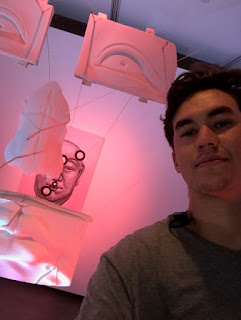
Last Tuesday, April 18th myself and a couple friends attended Linda Weintraubs lecture. As soon as we entered the lecture space we were greeted by a table with chips, water bottles and a delicious bowls of guacamole and salsa. The space to the left was set up as an art gallery with some of her projects put on display for people to walk around and look at. The piece that stood out to me the most was what look like a ceramic eyes, nose and lips connected together with strings having down from the ceiling. and behind it was a drawing of a face placed against the wall behind the ceramic pieces. In Lisas lecture she talked about Eco-Art, and how art can translate into helping the environment. I can relate to this on a personal level as I was raised by my father who is an artist and considers himself an environmentalist. My father has always taught me to respect the environment and especially the ocean. Because marine life has such an influence on his art, he has donated a number of his...